Reviewed evidence · Verifiable credential
Certification is earned, not attended.
TenXPros certification is awarded when your Living AI Solution Dossier meets an explicit review standard. The credential reflects reviewed AI adoption work, not video completion.
- Reviewed dossier
- Public criteria
- Verifiable badge
Credential
Certified- ArtifactLiving AI Solution Dossier
- Review statusAgainst 8 public criteria
- Credential decisionCertified · Strong Draft · Completed
- VerificationPublic page · Badge ID
What it means
What the credential signals.
A Certified TenXPro credential is a practical signal: it says specific, reviewable work was done, not that lessons were watched.
- 01A real professional problem was framed
- 02AI boundaries and risks were identified
- 03Use cases were chosen and prioritized
- 04An evaluation rubric and test set exist
- 05The workflow is usable
- 06Value is shown with evidence
- 07Governance and confidentiality are respected
- 08A realistic 100-day roadmap exists
The review standard
The eight review criteria.
Every dossier is reviewed against the same explicit, public criteria. The standard is visible before you apply, and it is the same standard that earns the credential.
- 01Problem clearly defined
- 02Risks and boundaries explicit
- 03Use-cases chosen and prioritized
- 04Evaluation rubric and test set exist
- 05Workflow is usable
- 06Value is shown with evidence
- 07Governance and confidentiality respected
- 08Roadmap is realistic
Review outcomes
Three outcomes. One standard.
Review is not pass/fail theatre. The same standard produces three honest outcomes.
Certified
The dossier meets the review standard and earns the credential.
Strong Draft
The work is close; specific revisions are returned before certification.
Completed
The program is finished; the credential is not yet earned. A real, professional outcome, not a failure.
Milestones, ranks & the seal
Milestones, ranks, and the final credential.
Progress is marked by reviewed work, not attendance, and it builds toward one credential.
Module milestones
11
One per core module, earned through the work you submit, not for watching or attending.
Ranks · progress through the method
- AI-Ready ProfessionalEarned on completing the Frame phase.Frame
- AI Problem Solver & Solution DesignerEarned on completing the Design phase.Design
- Future-Ready AI Solution DesignerEarned on completing the Prove and Foresee phases.Prove · Foresee
The final credential
Certified TenXPro Capstone Seal
The seal belongs to certified dossier work, earned when the reviewed dossier meets the standard. Verification confirms credential metadata without exposing the confidential contents of your work.
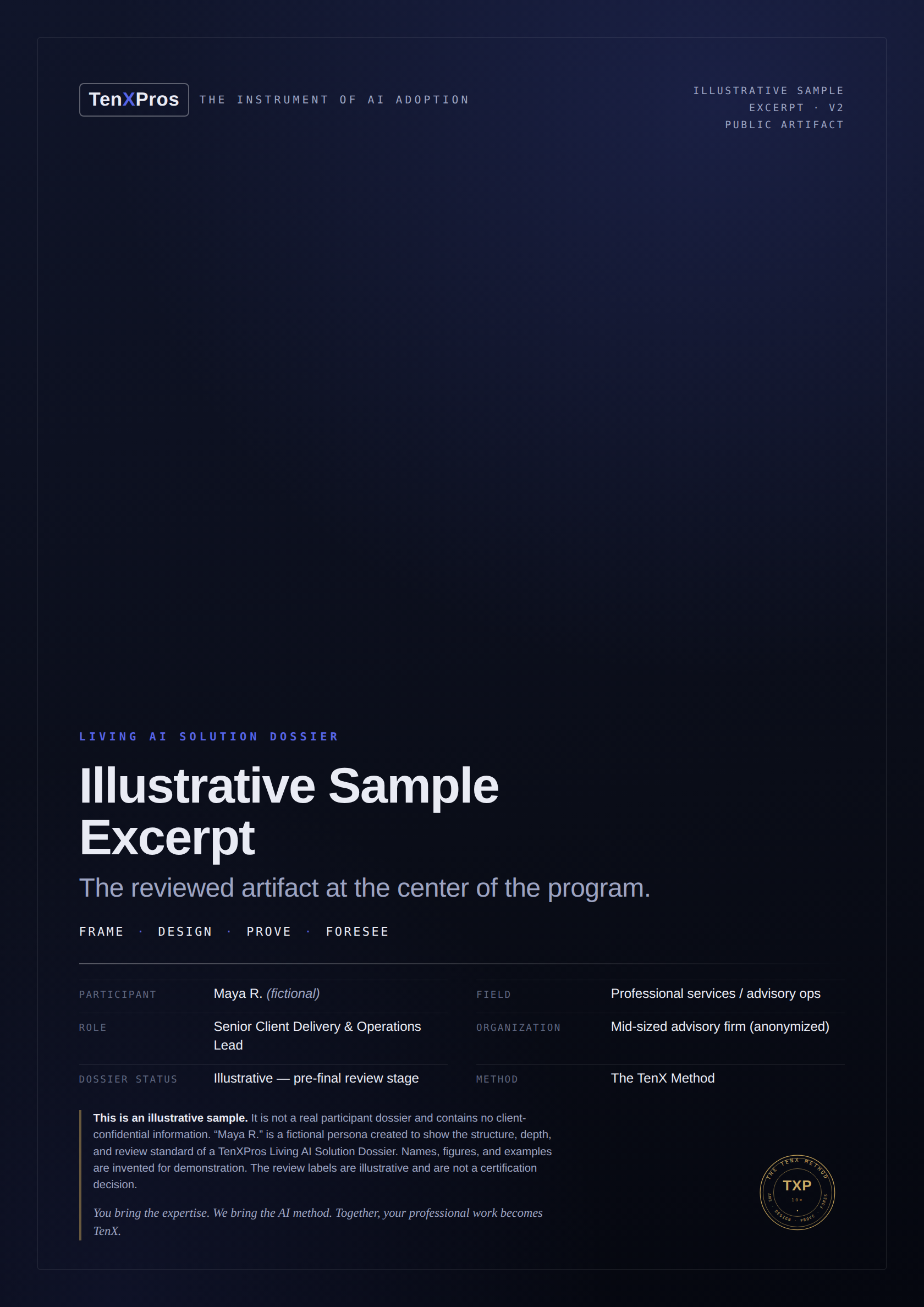 Living AI Solution Dossier · Cover
Work behind the credential
The credential has work behind it.
Before applying, you can inspect an illustrative dossier. It shows the structure, reviewer notes, an intentional evidence gap, and how the work maps to the rubric.
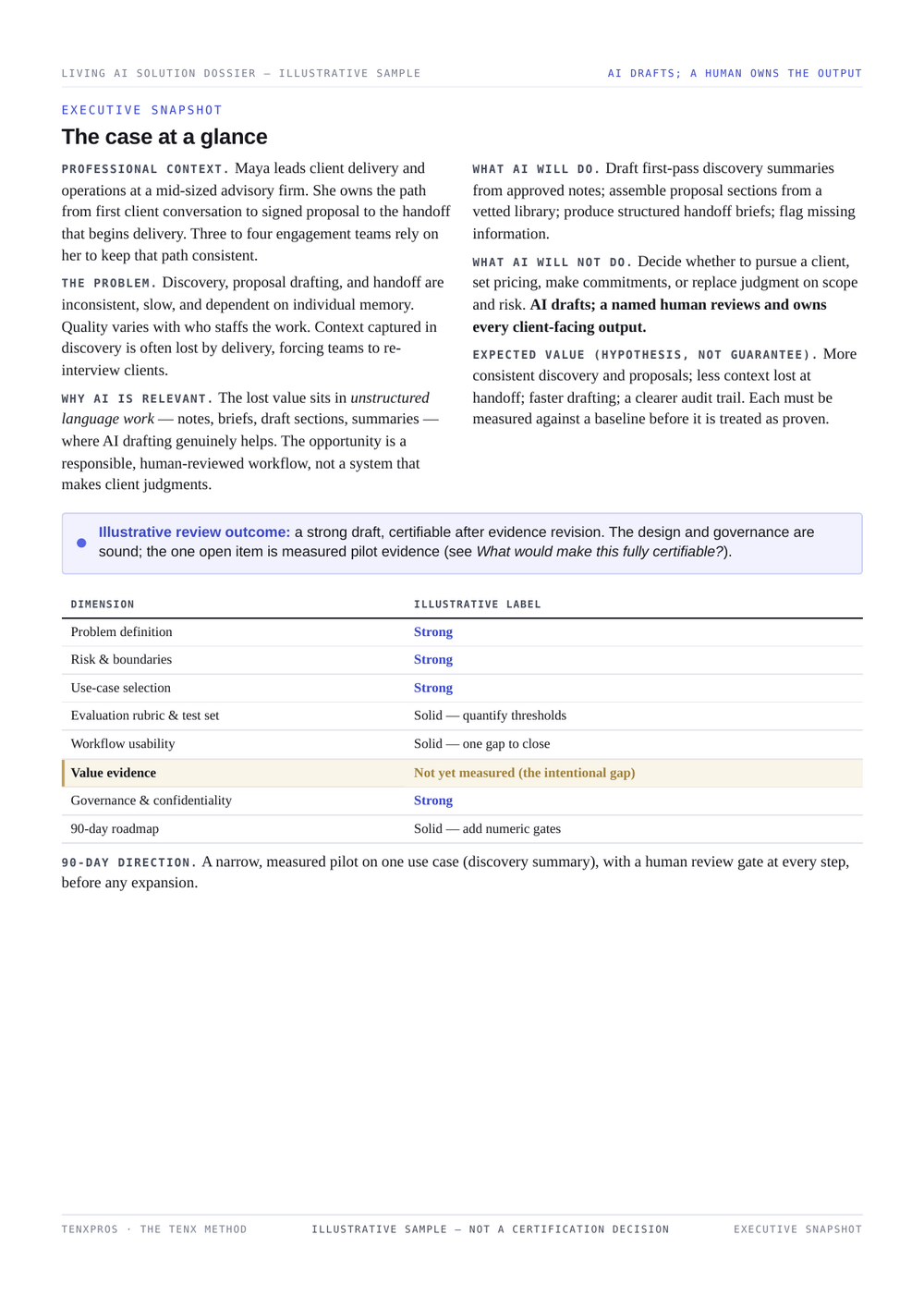
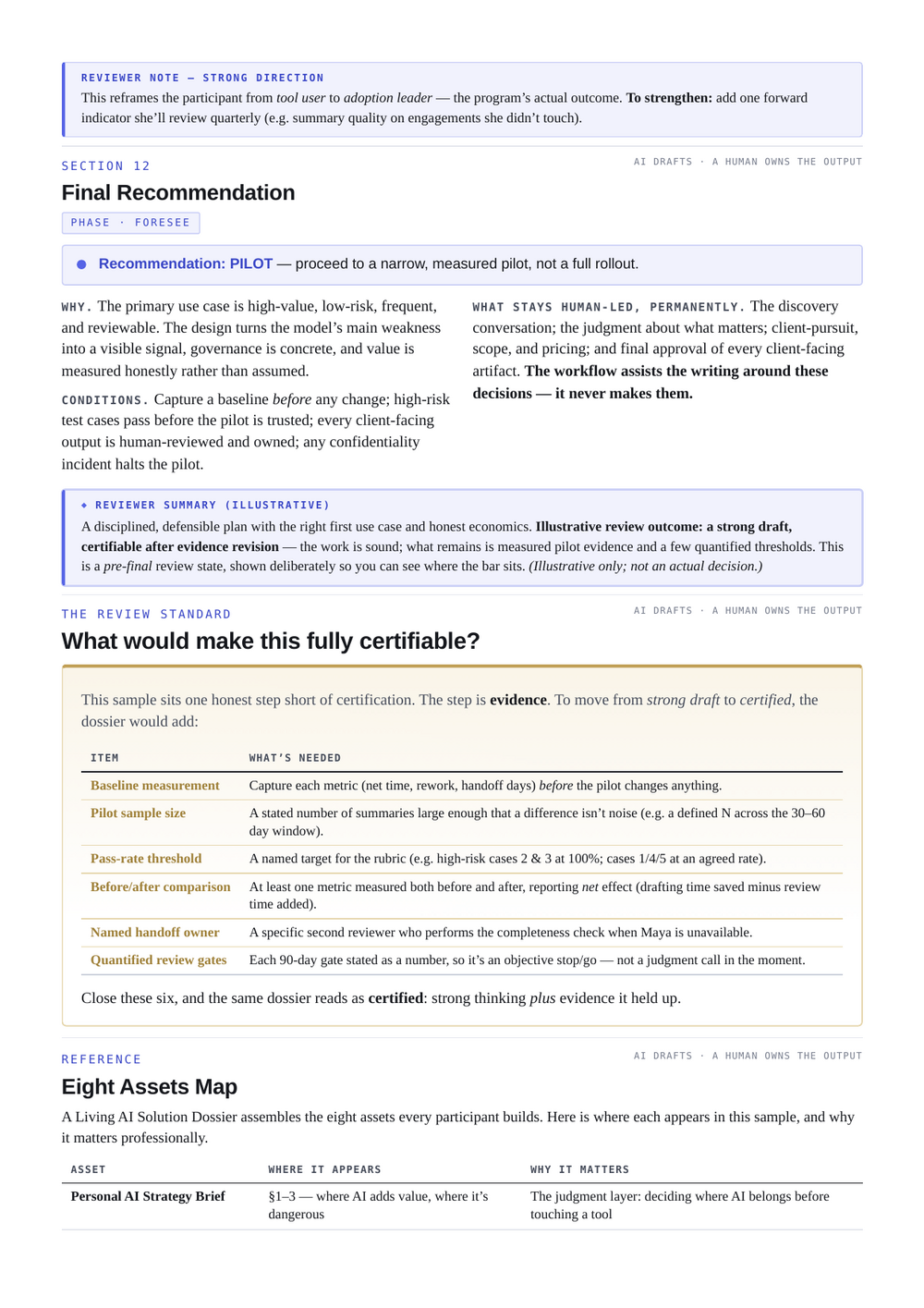
Illustrative sample. Fictional participant. No real client data. Review labels are illustrative, not a certification decision.
Review mechanics
How dossier review works.
Review is a human judgment against an explicit standard, not a quiz and not attendance.
- 01Your dossier is assessed against the eight public criteria, the same standard shown before you apply.
- 02The review is performed by a qualified human reviewer using the TenXPros review standard.
- 03For the founding cohort, review is handled directly by the TenXPros review team and program architect.
- 04Outcomes are Certified, Strong Draft, or Completed.
- 05A Strong Draft includes specific revision guidance; certification is earned only when the dossier meets the standard.
- 06Verification confirms credential metadata; it does not expose the confidential contents of your dossier.
Who reviews the dossier?
For the Founding Charter, dossier review is conducted by the TenXPros review team and program architect using the same eight public criteria. Review is human-led, section-specific, and based on the evidence in the dossier. As the program grows, additional reviewers may be added under the same published standard.
No certification outcome is guaranteed.
Verification
How verification works.
A credential is only as good as the ability to check it. When a credential is earned, it is issued with a public verification page, confirming the credential without revealing the work behind it.
- Each earned credential is issued with a public verification page.
- When a credential is issued, anyone can check it, its status, and its issue date.
- Verification shows recipient, credential status, issue date, and credential metadata.
- It does not expose the confidential contents of your dossier.
When a credential is earned, verification confirms credential metadata without exposing the dossier. View illustrative verification example.
- Recipient
- Illustrative · Maya R.
- Credential
- Certified TenXPro
- Status
- Active
- Issued
- Illustrative date
- Verification code
- TENX-0000-0000
Illustrative verification panel, not a real record. Live credentials are verified on a public page; no real personal data is shown here.
The path
How you get there.
- 01
Apply with your expertise
- 02
Complete the diagnostic and personalized path
- 03
Build the eight assets
- 04
Assemble the Living AI Solution Dossier
- 05
Submit for review
- 06
Revise if needed
- 07
Earn certification when the dossier meets the standard
- 08
Share the verifiable credential
Questions
Honest answers about the credential.
What makes the credential credible?
What does the reviewer check?
What if my dossier is not certified on the first review?
Can I still finish the program without earning the credential?
Can employers verify it?
How can I use the credential?
Does verification reveal my confidential work?
Is this suitable for non-technical professionals?
What if my field is regulated?
How is this different from a university or accredited program?
Founding Charter
Bring your expertise. Build work that can be reviewed.
Apply for the Founding Charter. Payment happens only after acceptance.